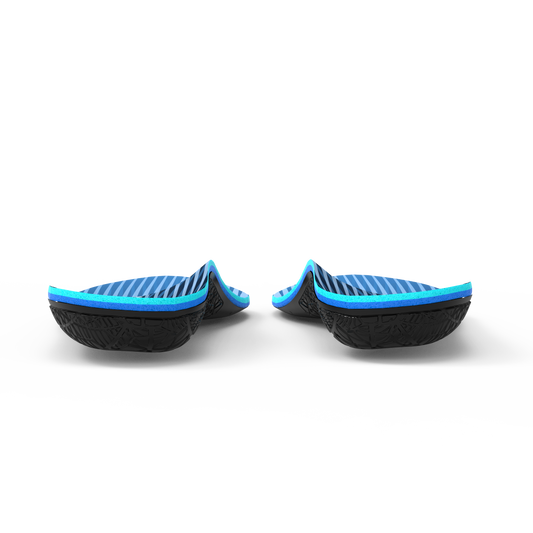
Dress shoes are built to look a particular way, and support is not part of the brief. The insole inside a new pair of oxfords is usually a piece of thin material glued to the board — decorative more than functional. Add a normal supportive insole and the shoe stops closing properly, the heel slips, or your foot sits too high in the vamp.
So most people who need arch support and also need to wear real shoes to work simply go without, five days a week.
The engineering problem is specific: you have almost no vertical room, and you still need the arch to make contact. Thin foam that holds an arch shape under load is harder to make than thick foam that does — there is less material to do the same job, so the material itself has to be better.
Which brings up the thing that makes thin insoles fail even faster than thick ones.
Almost every insole is built from closed-cell foam — sealed gas bubbles in a rubber matrix. Under repeated load, the bubble walls collapse and stay collapsed. The industry calls it pack-out. In a thick insole you might not notice for a few months. In a thin one there was never any spare height to lose.
We call this the Pack-Out Problem.
Fusion is our answer to it, and it is the hardest thing we make.
At 4mm it is the only insole in our line that fits a dress shoe. The rest of the range is 5mm, which sounds like a rounding error until you try it — in an oxford or a loafer, that millimetre is the difference between a shoe that closes properly and one that does not.
Fusion is exactly what the name says. Where our other models use a single 4mm foam, Fusion uses two, fused: 1.5mm of the same soft foam that goes into Embrace, bonded to 1.5mm of a firmer support layer. Soft where your foot lands, firm where it needs to hold.
Doing that in less space than the single-foam models use is the difficult part. The thinner the layers, the less room there is for the bond to be anything but perfect. That is why Fusion costs more than our standard line — not a different tier of quality, a harder thing to build.
Both foams are open-cell, so air moves through the material as it loads and unloads. It displaces instead of crushing, and recovers between steps. Look at the cut edge and you can see both layers.
It is the one you wear to work, to the wedding, and through the conference where you are standing in the hallway for three hours.
FAQ
Will it fit in a slim dress shoe?
That is what it is built for. Remove the factory insole first — in most dress shoes it comes out, and taking it out frees up more room than Fusion takes up.
Can I use it in sneakers too?
Yes, though in a shoe with room to spare you would get more out of Embrace or Plush.
Is it worth the extra over the standard line?
If your problem is that nothing fits in your work shoes, yes. If you have room for a normal insole, save the money.