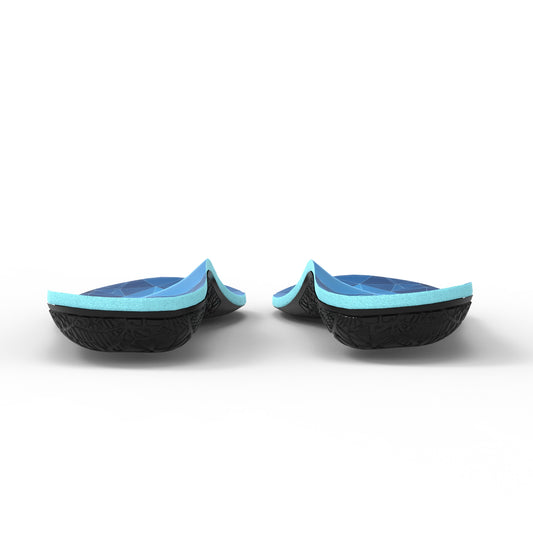
If you have wide feet, you already know the compromise. You finally find shoes that fit. Then you add an insole for support, and the shoe stops fitting.
Part of this is unavoidable — anything you put in a shoe takes up room. But two things make it worse than it needs to be. The first is trimming: most insoles come oversized and get cut down to fit, and a rushed trim leaves an edge that bunches against the side of the shoe. On a wide foot, where there is no spare width to give, that edge is the difference between comfortable and unwearable. Trim carefully, use the factory insole as your template, and cut less than you think you need — you can always take more off.
The second thing is worse, because you cannot fix it with scissors.
Almost every insole in the category is made of closed-cell foam — sealed gas bubbles in a rubber matrix. Under repeated compression, the bubble walls collapse permanently. The industry calls this pack-out. You spent weeks getting used to a shoe-and-insole combination that fit, and the fit changed underneath you without you noticing.
We call this the Pack-Out Problem.
PerseveranX uses open-cell foam. Interconnected cells let air move through as the foam is loaded and released, so it displaces rather than crushes and recovers between steps. What fit in week one still fits in month four — which matters more for a wide foot than for anyone else, because there is no spare room to absorb the change.
Which one: Embrace is the practical first pick — the most forgiving underfoot in the lowest overall profile. If your shoes have depth to spare and the priority is comfort over room, Plush is the softer option.
FAQ
Should I size up for wide feet?
Order your normal size. Take the factory insole out before inserting ours, and you will usually recover more room than you lose.
Can I trim these to fit? Can I trim these to fit?
Yes, and for wide feet the trim matters more than usual. Take the factory insole out, lay it on top of ours as a template, and cut to that line — not to the printed size markings, which assume a standard width. Cut conservatively and test the fit before taking more off.
What if my shoes are already tight?
Removing the factory insole is the first move. If it is still tight after that, the shoe is the problem, not the insole.